
OCARnet Project Overview and Objectives
The Ohio Communications and Computing ATM Research Network (OCARnet) is a recently funded project of the Ohio Board of Regents (OBOR) Investment Fund. This project is designed to establish an
ATM network in Ohio for the purpose of conducting state-of-the-art research in areas of high speed, high bandwidth networking and its applications. OCARnet will enable multiple research projects that are similar in scope to those specified in the stategi
c High Performance Communications and Computing Research Program of the National Science Foundation (NSF).
Research and Educational Goals and Objectives
Asynchronous Transfer Mode (ATM) Technology is expected to be the key technology in the current plans for our National Information Infrastructure (NII) and the upcoming Global Information Infrastructure (GII). This technology is gaining popularity for
both telecommunication as well as computer networks
due to its capability of providing high-bandwidth data transfer in real time. With the availability of this new technology, many new applications are becoming viable. These include parallel/distributed computing with networks of workstations (NOW), mult
iprocessing/heterogeneous computing with
geographically distributed machines, multi-media access including full color images, sound, video, and virtual reality images, the World Wide Web (WWW), Electronic Data Interchange (EDI), distance learning, and video on demand. To support such a large nu
mber of applications with various types of traffic and different quality of service (QoS) on an ATM network, many basic networking
research problems need to be solved. These include routing, congestion control, circuit allocation and management, testing, and performance evaluation. Similarly, research and evaluation in the areas of network
management and inter-operability of hardware and software are needed to provide a reliable ATM network.
Solutions to many of these problems not only require creative ideas and concepts but also the availability of an experimental research network. Such a network, unlike a production network, provides flexibility to experiment and
validate the ideas and concepts and thus demonstrates the significance of the solutions. In this research, such an experimental ATM research network is being planned to be established in Ohio to facilitate multiple research directions related to ATM netw
orking. Six universities/institutions in Ohio are planned to
be connected through this network. Figure 1 provides an overview of the proposed OCARnet. This infrastructure will serve as the prototype for the next-generation backbone for OARnet. OARnet provides network connectivity to both
public and private educational institutions in Ohio, as well as to dozens of major businesses throughout the state. Therefore, this project has immense potential for impact on the research, educational, and commercial future of Ohio.
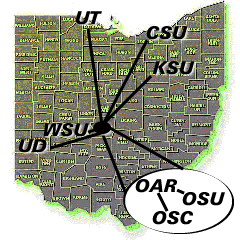 Overview of the proposed OCARnet (Ohio Computing and Communications ATM Research Network) connecting The Ohio State University (OSU), the Ohio Supercomputing Center (OSC), OARnet (
OAR), Kent State University (KSU), Cleveland State University (CSU), University of Toledo (UT), Wright State Univ
ersity (A HREF="http://www.wright.edu">WSU), and the University of Dayton (UD).
Overview of the proposed OCARnet (Ohio Computing and Communications ATM Research Network) connecting The Ohio State University (OSU), the Ohio Supercomputing Center (OSC), OARnet (
OAR), Kent State University (KSU), Cleveland State University (CSU), University of Toledo (UT), Wright State Univ
ersity (A HREF="http://www.wright.edu">WSU), and the University of Dayton (UD).
The following six research projects related to ATM networking are planned to be be carried out on the OCARnet. This research falls into four main categories: testing and performance evaluation, parallel/distributed computing,
inter-operability, and network management. Researchers from the participating universities/institutions will be working in a co-operative manner to derive solutions to these problems.
- Ohio National ATM Performance Benchmarking Lab (OSU, OARnet/OSC)
- Collective communication support on ATM-connected Networks of Workstations for parallel computing (OSU, OARnet/OSC)
- Parallel computing with networks of workstations (UD, OARnet/OSC)
- Thread migration for high-performance distributed computing (KSU, CSU, OARnet/OSC)
- ATM circuit allocation and management (UD, OARnet/OSC)
- Inter-operability and network management (OARnet/OSC)
Potential for Economic Growth in Ohio
Networking is one of the fastest growing research areas in computer science. The US Government is planning to invest several billion dollars in this area through its High Performance Communications and Computing (HPCC)
program. Also, the recent growth of Information Superhighway and the promise of the National Information Infrastructure and the Global Information Infrastructure have attracted the commercial sector to invest heavily in this area. Currently at a nationa
l level there is a void in terms of testbeds for ATM
networking research. The State of Ohio's investment in this area will bring the visibility required by universities and the region to show its leadership in this area.
It is worth noting that in a memorandum to Provosts and Graduate Deans summarizing the OBR's review of Ohio's PhD-granting programs in Computer Science, E. Garrison Walters stated on behalf of the OBR, ``...computer science is an area of high priority
, and one for which there appears to have been
chronic underfunding,'' and that ``increased investment in computer science is warranted; there are research areas in which Ohio could be highly competitive.'' We feel that this proposal represents an ideal opportunity to partially compensate for this ch
ronic underfunding and to simultaneously boost the
competitiveness of Ohio Universities in leading-edge research areas. The funding of this research will provide the necessary infrastructure to allow the participating universities to successfully compete for federal funding for research in HPCC.
It is also to be noted that many other states in the nation have already started such programs that encourage research in networking, telecommunications, and computing. Georgia and North Carolina currently seem to be on the leading edge of these rese
arch areas. They started ATM
testbed programs about three years ago when the ATM technology was in its infancy. Those testbed programs have led to vast research growth in these areas, which include substantial external research funding and endowed
chairs in their state universities. Such growth is also possible in the State of Ohio with the availability of a testbed.
Besides research activities, the existence of the testbed environment will be a tremendous boon to the teaching of experimental computer science at both the graduate and undergraduate level at Ohio universities. It is increasingly
becoming important to our students (for their competitiveness in the job market) and to their future employers that we produce graduates who are well versed in the techniques of experimental computer science in addition to the theoretical, mathematical an
d programming techniques which have made up the traditional computer science curriculum. Experimental techniques involve designing,
conducting and interpreting measurements, developing and evaluating computer models, validating models via measurements, performance tuning, the injection of faults into systems, and security audits. It is very difficult to teach these techniques or cond
uct this kind of work on the general purpose
computing equipment that is normally available for computer science classes; this work needs to be done in a controlled, laboratory environment where interactions may be limited. This proposal will provide such a laboratory environment that will be lever
aged for both instruction and research.
OARnet is participating in this proposal to develop their next generation of infrastructure to support networking in Ohio. OARnet not only provides internet connectivity to Ohio's colleges and universities, but also to many businesses
throughout the state. OARnet expects to see significant growth in this portion of their customer base, and therefore needs to increase the capacity of their backbone network spanning Ohio. This project will provide them the means to
develop ATM expertise that will directly benefit businesses in Ohio as increase their dependence on network technology.
Columbus industry is already looking forward to benefiting from the ATM technology. The Industry and Technology Council (ITC) at Columbus is working to develop an ATM testbed called the ``Columbus ATM Networ
k (CATNet)'' to
connect leading businesses in the area. The Ohio State University is providing the technological leadership to this project. The knowledge gained from OCARnet will be transferred directly to those businesses.
Potential for Building Collaborative Partnerships
Establishment of a research network always results in collaboration, both planned and unforeseen. The ATM research network will be a unique resource which will be highly leveraged by researchers at participating universities/institution in Ohio, and a
cross the nation. Further, the parallel and distributed computing and multimedia components in this research network will provide synergy across various research groups in Ohio universities, research centers (such as the
Liquid Crystal Institute at Kent), and industries, who are using current supercomputing facility at OSC, to develop collaborative research activities.
Litel Communications Inc (LCI) is a national long distance telecommunication carrier with headquarters in Columbus. They have expressed interest in establishing and supporting collaborative research programs on this A
TM testbed. We are currently investigating the possibility of their support. Strategic Network Consulting Inc (SNCI) coordinates university-industry relationships for networking performance measurements at Harvard Unive
rsity. SNCI has also approached us and expressed interest in supporting the proposed testbed. They will help us obtain ``system under test'' from vendors to carry out testing of new ATM networking components. A letter of support indicating this collabo
rative effort is attached.
General Budget and Description
The day-to-day operation and maintenance of the network will be
under the control of systems support staff at the housing
institutions. Each institution will be responsible for the
maintenance costs associated with the equipment housed there, and for
providing the necessary space to house the equipment.
OARnet will be providing the network connectivity to
connect the participating institutions.
Both OARnet and OSC have a tradition of providing 24-hour by 7-day a week
operation. The ATM research network will be monitored and supported
exactly as the existing OARnet service. Both centers will use existing
operational funds to acquire any needed hardware maintenance.
The successful pursuit of this research will have outcomes along three directions. First, the research network will facilitate in deriving state-of-the-art research results by the participating investigators in ATM networking, performance evaluation, p
arallel/distributed computing, and network management. Second, it will generate a synergy between Ohio universities, institutions, and industries for collaborative research in HPCC areas. Third, the system will have strong educational impact on the use an
d development of state-of-the-art networking and distributed systems. This training will translate directly into benefits for Ohio's economic health, as the students move into the workforce for Ohio industry.
The PI, Raj Jain, together with other co-PIs will form an executive board. This board will meet frequently and evaluate research progress of this consortium. It will also decide future strategic plans to initiate new collaborative research programs in
order to attract external funding from Federal and private sources.
Potential for receiving Future Support
The proposed research testbed will be very crucial to attract federal funding for HPCC projects related to ATM Networking. Since major components of this are experimental in nature, most of the time the decisions by external funding agencies are depen
dent on the the availability of such a testbed. Currently collaborative research effort between the faculty members at each participating institution are in progress to carry out large-scale ATM networking and application research. These have a lot of pot
ential to attract external funding from agencies like NSF, NIH, ARPA, and ONR as well as from industries.
Specifically, one proposal by Drs. Jain and Panda is under review by NSF to obtain equipment for multimedia and distributed computing using ATM networks. Dr. Chapin is in the process of submitting research proposals to the Army, Air Force, and Nationa
l Science Foundation for research projects in distributed scheduling, distributed operating systems, and secure distributed processing. All of these projects would take advantage of the infrastructure proposed here. Drs. Blake, Lin, and Sang are submittin
g an equipment proposal to the National Science Foundation for research in parallel/distributed and wireless computing. If granted, these projects could be incorporated together to yield new investigation in connecting ATM with wireless networks.
REGISTER with OCARnet.
REGISTER with vBNS.