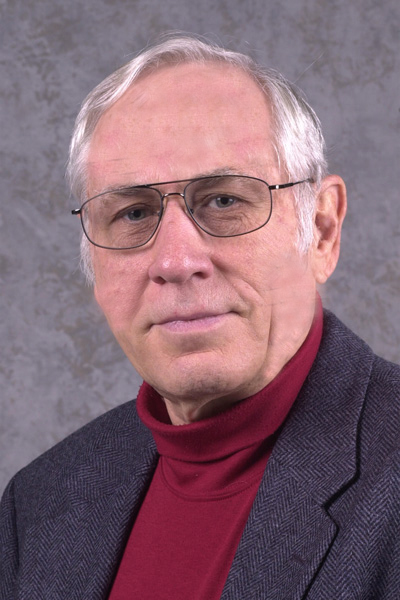
Johnnie W. Baker


Contact Information    
Snail Mail Dr. Johnnie W. Baker
Department of Computer Science
Kent State University
Kent, Ohio 44242
   
Office Phone 330-672-9061 Lab Phone 330-672-2074
Office Room 260 Lab Room 357
Office Hours 1:00-2:00 MWF FAX 330-672-7824
Email jbaker@cs.kent.edu    


Short Biography:

Johnnie Baker received his bachelors degree from Hardin-Simmons University and his masters and Ph.D. degree from University of Texas in Austin. He was a faculty member at Florida State University prior to joining the faculty at Kent State University in 1973. In addition to computer science, he also has publications in mathematics (both Banach Spaces and general topology) and computational chemistry. He has graduated 5 Ph.D students and over 25 masters students and is currently supervising 5 Ph.D. and 5 masters students. He has refereed for numerous conferences and journals, and since 1991 he has served as an editor for Parallel Processing Letters. Starting back in 1974, Baker led the effort within the Mathematics Department to establish a computer science program at KSU. Following the creation of a computer science program in 1978, he held the top administrative position within computer science for over 25 years, including being the founding chair of the Computer Science Department during 2001-2005. He is a member of both ACM and the IEEE Computer Society.

Fall 2007 Courses:

Some Courses Taught Recently:

Research Interests:

Baker's current research interests in parallel computing include parallel algorithms, parallel modelling & simulation, associative SIMD & multi-SIMD computing, massively parallel architectures, and SIMD real-time air traffic control. His computational chemistry interests include molecular similarity analysis, structure-activity visualization, molecular engineering, and drug design.

Research Groups:

Current Research Activities:

A major focus of Baker's current research has been the development of a Multi-SIMD model of computation called MASC (for Multiple ASsociative Computing) that supports associative computing. In particular, MASC is a data parallel and control parallel hybrid with the SIMD threads being managed using control parallel methods. Previous and current work investigates the power of MASC by comparing it to other models of computation such as PRAM, MMB, and BSP and by establishing efficient algorithms for MASC and comparing these to algorithms to those for other models. Current work also pursues the building of a simulator for the MASC model. This involves building a run-time system for MASC that uses the manager-worker control paradigm to control the multiple SIMD threads, extending a previous language and compiler for an associative SIMD computer to a language and compiler for MASC. It is hoped that this simulation will lead to an implementation of MASC using future research of Dr. Robert Walker and his students on use of FPGAs to supports multi-SIMDS systems.

A second focus of Baker's research has been the investigation of efficient associative SIMD solutions for air traffic control (ATC). Unlike current and past multiprocessor solutions, this approach can avoid dyamic task scheduling, distributed data bases, and other aspects of past implementations that cause the these ATC systems to be extremely expensive, highly complex, and unable to process all of the data available for processing. Also, the SIMD solution will provide the ability to accurately predict the running time of various tasks that currently can not be supported. A recent paper provided a detailed analysis of the execution times for key tasks on the WorldScape CS301 SIMD COTS system. Currently, an implementation of this SIMD ATC solution is being investigated using the WorldScape CSX600 SIMD COTS system.

A third focus of Baker's current research area has been developing sequential and parallel algorithms to measure the similarity between different molecules and using this information to predict properties of unknown compounds and to engineer drugs and compounds with certain desirable properties and structure. This is joint work with Professor Chun-che Tsai in the Department of Chemistry at Kent State.

Links to Papers, Publications, Vita:

Family Links and Photos: