[TEXT:
721-741, 760-766]
Illumination Models
-
local illumination
-
defines single-light, single-surface interaction
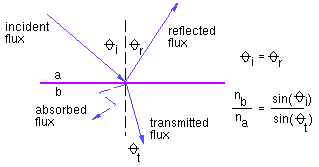
-
global illumination
-
models interchange of lights between all surfaces
Local Illumination Models
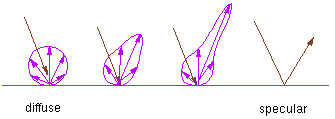
Traditional graphics LIMs are:
-
fast to compute
-
heuristic and incomplete (non-physical)
-
most interested in light in direction of viewpoint
Most such adhoc illumination models have three components:
I = ambient + diffuse + specular
The ambient term allows for some global control of brightness in a scene.
Typically,
I = Ia ka
where Ia is an ambient illumination constant defined once for the
entire scene, and ka is an ambient reflection coefficient, usually
restricted to lie in [0,1].
Diffuse Reflection
-
Lambertian reflection
-
apparent surface brightness independent of viewing angle
-
distribution of scattered light is independent of direction of arriving
light
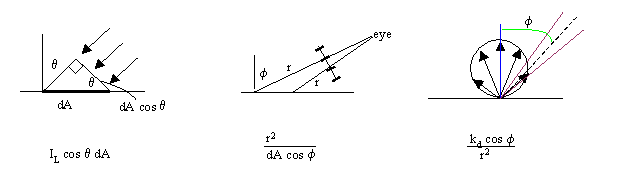
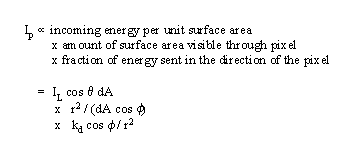
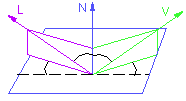
Id = Ii k_diff cos(th), th in [-pi/2, pi/2]
    = Ii k_diff (N.L),   N.L  0 and assuming N and L are          normalized
Ii: intensity of light source i
k_diff: surface reflection coefficient
th: angle between N and L
Phong Specular Reflection
The last component of the commonly-used local illumination model is one
that takes into account specular reflections. The following figure illustrates
the situation:
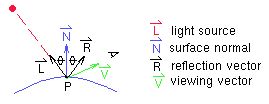
The Phong illumination model is one often-used method of calculating
the specular component:
  Is = Ii k_spec cos^n(alpha)
     = Ii K_spec (R.V)^n
where k_spec is a specular reflection coefficient and alpha is the angle
between the reflection and viewing vector. The surface parameter 'n' can
be thought of as describing the surface roughness, where an ideal mirror
would have n=¥ , and a rough surface might
have n=1.
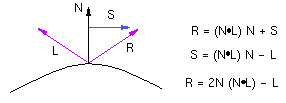
How can R be computed?
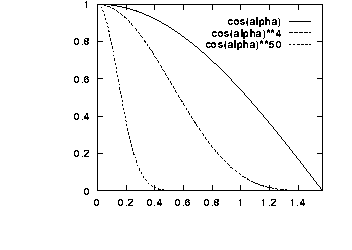
The function cos^n(alpha) looks as follows:
The Blinn Specular Model
Blinn reformulated the specular reflection model so that it agreed better
with experimental results. It makes use of a halfway vector, H, as follows:
Is = Ii k_spec cos^n(alpha)
     = Ii K_spec (N.H)^n
 The advantages of this model
include:
The advantages of this model
include:
-
theoretical basis
-
N.H cannot be negative if N.L>0 and N.V>0
-
for a directional light and an orthographic projection, H is constant
The Complete Model
Combining the various models and assuming the Phong illumination model
gives:
I = Ia ka + Ii k_diff (N.L) + Ii k_spec (R.V)^n
where each of ka, k_diff, and k_spec are parameters which are associated
with specific surfaces and take on values between 0 and 1. To deal with
colour, three equations of the above form are typically used:
I_r = Ia_r ka_r + Ii_r k_diff_r (N.L) + Ii_r k_spec_r (R.V)^n
I_g = Ia_g ka_g + Ii_g k_diff_g (N.L) + Ii_g k_spec_g (R.V)^n
I_b = Ia_b ka_b + Ii_b k_diff_b (N.L) + Ii_b k_spec_b (R.V)^n
Some other problems and their adhoc solutions:
-
What should be done if I1?
-
Clamp the value of I to one.
-
What should be done if N.L < 0?
-
Clamp the value of I to zero or flip the normal.
-
How can we handle multiple light sources?
-
Sum the intensity of the individual contributions.
Shading Algorithms
-
flat shading
-
Invoke illumination model (IM) once for the polygon, use this as a colour
for the whole polygon
-
Gouraud shading
-
Compute IM at the vertices, interpolate these colours across the polygon
-
Phong shading
-
Interpolate normals during scan conversion, apply IM at every pixel. (note:
renormalization problem)
Problems with shading algorithms
-
orientation dependence
-
silhouettes
-
perspective distortion
-
T-vertices
-
generation of vertex normals
Lighting models in OpenGL
The following are calls which set the parameters of a light:
  glLightfv(GL_LIGHT0, GL_AMBIENT, amb_light_rgba );
  glLightfv(GL_LIGHT0, GL_DIFFUSE, dif_light_rgba );
  glLightfv(GL_LIGHT0, GL_SPECULAR, spec_light_rgba );
  glLightfv(GL_LIGHT0, GL_POSITION, position);
  glEnable(GL_LIGHT0);
The following calls define the surface properties to be used for all subsequently
drawn objects.
  glMaterialfv( GL_FRONT, GL_AMBIENT, ambient_rgba );
  glMaterialfv( GL_FRONT, GL_DIFFUSE, diffuse_rgba );
  glMaterialfv( GL_FRONT, GL_SPECULAR, specular_rgba );
  glMaterialfv( GL_FRONT, GL_SHININESS, n );
Physics-based Illumination Models
-
BRDF: bidirectional reflectance distribution function

-
measuring BRDFs: gonioreflectometer
-
analytical models
-
statistical microfacet models
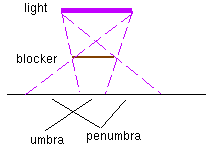
Shadows
-
projective rendering
-
draw object a second time with additional shadow transformation
-
darken existing image
-
use stencil buffer to prevent `double shadows'
-
raytracing
-
part of method
-
cast shadow ray
-
area light sources