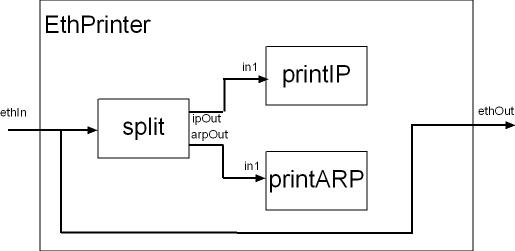
A NetScript network consists of a collection of network nodes (e.g. PCs, switches, routers) each of which runs one or more NetScript engines. A NetScript engine is a software abstraction of a programmable packet-processing device. Each NetScript engine consists of dataflow components, called boxes in NetScript, that process packet-streams that flow through them. .Packets that flow through a NetScript node are processed by successive boxes to perform various protocol functions. Typical NetScript boxes do packet header analysis, packet demultipexing, or other protocol functions.
NetScript boxes can be dispatched to remote network engines and dynamically connected to boxes that reside there to extend the network with new communication functions. NetScript uses interconnection to achieve protocol composition--composite packet-processing protocols are built by connecting together the typed ports of boxes. For example, an IP router implemented in NetScript could be dynamically extended with firewall functions. Or such a router might be extended to monitor traffic, support content-filtering on the edge of a network domain, or perform load balancing and traffic shaping. NetScript is useful in any application that process packet-streams.
The NetScript system consists of two components: NetScript, a textual dataflow language for composing packet-processing protocols and a the NetScript Toolkit, a set of Java classes to which the textual language compiles. This release of NetScript includes the NetScript Toolkit but not the front-end language language, which will be introduced in the next version of the system. The language will consist of three integrated components -- a dataflow composition language, a presentation language for defining the format of network packets, and a classification language for building packet classifiers. Even without the language, we hope that the NetScript Toolkit prove useful as a framework for building active protocols.
This tutorial shows how to program with the NetScript toolkit. In what follows, I first introduce the NetScript language and its computational model. Then, I describe the underlying toolkit. I use the language to describe main concepts in the Toolkit. Each language construct maps to an equivalent class in the NetScript toolkit. Therefore, an understanding of NetScript's dataflow model and constructs will help you quickly master the Java classes in the Toolkit.
Impatient readers may want to skip directly to the examples. The NetScript distribution comes with a number of example protocols, including Ethernet, ARP, IP, etc. These protocols, located in the package netscript.protocol, can be used as templates for creating new protocols.
Dataflow is different from conventional imperative programming languages such as C or Java in a number of ways. First, program or protocol composition is achieved through interconnection. One composes dataflow programs by connecting together simpler boxes. In imperative programming, the unit of composition is the function. Second, dataflow is data-driven. It is the asynchronous arrival of data messages and their flow through the dataflow graph that determines what boxes are computing and what are not. Multiple boxes can be executing concurrently. In imperative languages, the program counter determines which part of the program is active. Finally, dataflow provides a simple model of concurrency and synchronization. All data must flow through the formal interfaces of a box (i.e., its ports). There is no global or shared concurrent state between boxes. Thus there is no need for primitives for synchronizing shared state (i.e. mutex locks, semaphores, etc).
NetScript's dataflow model permits dynamic composition of protocols. Boxes can be dispatched to NetScript nodes and connected to boxes that reside there in order to extend the network with various functions. For example, a running IP router written in NetScript could be extended dynamically with firewalling, protocol analysis, or traffic-shaping capabilities.
NetScript is not a complete language for doing general-purpose computation. Rather, it is useful to view NetScript as a coordination language, one which separates the logical organization of a concurrent system (box composition, interconnections) from how sequential computation in each component is achieved. NetScript's fundamental constructs (boxes, ports, messages) are exported through a minimal set of extensions to Java.
This section is an overview of boxes, inports, outports, box composition, and messages. We will use a couple of examples to help explain the concepts.
The syntax for box is
box-declaration :: "box" name "{" (box-body-declaration)* [connect-declaration] "}"

box-body-declaration :: inport-declaration |
                        outport-declaration |
                        field-declaration |
                        method-declaration

connect-declaration :: "connect" "{" [name "->" name ";"]+ "}"
There are actually two kinds of outport: one-way outports and two-way outports. An outport is one-way if its declaration does not specify a return type. This means that the outport only generates data but does not expect a reply. A one-way port is asynchronous. send simply enqueues its arguments for delivery to all connected inports, and returns immediately. A port need not be connected to anything. If an outport is not connected to any dowstream boxes, its message stream is transparently dropped.
A two-way outport declares a return type. This means that a two-way outport expects a reply. It also means that at most one inport can be connected to a two-way outport. A two-way port is synchronous. send delivers its arguments to receiving inport and waits until the handler for that inport has generated a reply. Two-way ports allows the destination inport to return a result to the calling outport.
Unlike the function call in imperative programming, a box outport need know to what inports it has been connected. For example, an IP router box might include a two-way outport that looks up routes for incoming IP packets. This outport could be connected to either a RIP or OSPF or BGP routing policy manager box at various nodes depending on the particular routing protocol being used in the network. Thus box composition provides true encapsulation and information-hiding.
The syntax for an outport declaration is:
outport-declaration :: "outport" type name "("  formal-parameters ")" ";"

formal-parameters :: [formal-parameter ("," formal-parameter)*]
formal-parameter :: type variable-declarator-id
variable-declarator-id :: ID ["[" "]"]
The type of a formal parameter is one of the Java primitive types
(boolean, char, byte, short, int,
long,
float, double, String), a class that implements
the interface netscript.kernel.msg.Copyable, or an array of one
of these types.
The syntax for an inport declaration is:
outport-declaration :: "inport" type name "(" formal-parameters ")" (java-block | ";")
box EthPrinter
{
  inport void ethIn (Eth m);
  outport void EthOut (Eth m);

  // declarations for internal boxes
  EthSplitter split;
  ARPPrinter printARP;
  IPPrinter printIP;

  connect
  {
    ethIn -> split.ethIn;
    ethIn -> ethOut;
    split.ipOut -> printIP.in1;
    split.arpOut -> printerARP.in1;
  }
}
The connect operator (->) connects a port of one box to the port of another. NetScript uses dot notation to refer to ports within a box. Thus split.in1 refers to the in1 port of split.
Port connection is strongly typed. Therefore a connection is valid only if the signatures of the two ports match. The signatures of two ports match if both have the same number of formal arguments and the type of each respective parameter also matches. Even when ports can be connected dynamically, port types are checked to ensure that NetScript the composition is type safe.
NetScript also allows connections from outport to outport, from inport to inport, and inport to outport. However, such connections are only allowed on the 'inside' of a box to connect a port of the enclosing box to the port of an internal box. In the example above, the connection from inport ethIn of EthernetPrinter to inport in1 of split is an inport to inport connection. Typically, such connections simply forward messages to the next connected port. Thus messages arriving on ethIn are forwarded directly to the in1 port of split. A internal connection (inport to inport, outport to outport, inport to inport) is legal only the number and types of the two ports are the same.
The NetScript compiler takes a box description as the one above and translates it into an equivalent Java source (subclasses of box, inport, and outport). This translated source is passed to a Java compiler to create byte-code classfiles that are dynamically loaded at NetScript engines. When dynamically loaded at remote NetScript engines, compiler-generated code in the box constructor creates internal boxes and makes connections between these. NetScript comes with a Java class library that allow NetScript boxes to dynamically create boxes from Java, make connections between boxes, query engine and box state, and so on.
box EthSplitter
{

  outport void ipOut (EthPacket eth);  // outport type declaration
  outport void arpOut (EthPacket eth); // outport type declaration

  inport ethIn (EthPacket eth)         // inport type declaration
  {
        short proto = eth.getProto();
    if (proto == 0x800)                // IP packet inside
    {
      ipout.send (eth);                // send packet to ipout outport
    }
    else if (proto == 0x806)           // ARP packet inside
    {
          arpout.send (eth);               // send packet on arpout outport
    }
  }

  // port instance declarations
  public ipOut ipout;
  public arpOut arpout;
  public ethIn ethin;

}
A body of a NetScript event-handler is written in Java. Any code that can appear in a Java method body can be used in the NetScript event-handler, except that the handle body must not propagate any Java exceptions.
When a message arrives at the an inport that contains an event-handler, the NetScript runtime system assigns incoming arguments to respective arguments of the event-handler and calls the event-handler. The event-handle runs atomically to completion.
In the example above, the body of the event-handler is a simple if statement. This if statement demultiplexes the input stream based on the proto field in the incoming Ethernet frame. It uses send() to direct IP packets to the ipOut outport and ARP packets to the arpOut outport.
All the classes described here are part of the package netscript.kernel. The accompanying javadoc documentation provides provides further information on individual classes.
In order to create a new box, you need to subclass netscript.Box. For each box outport with a unique signature you need to subclass netscript.kernel.Outport. Similarly, each box inport with a unique signature will need to subclass netscript.kernel.Inport.
To introduce a new packet type, for instance to process UDP packets, you will need to subclass netscript.lang.kernel.msg.Packet..The package netscript.protocol.* provides packet format definitions for a number of common protocols (e.g., Ethernet, ARP, IP, UDP, etc).
import netscript.kernel.Box;
import netscript.kernel.Inport;
import netscript.kernel.Outport;
import netscript.protocol.ethernet.EthPacket;

class EthPrinter extends Box
{
  // inport and outport declarations
  public EthInport ethIn;
  public EthOutport ethOut;

  public init (String args[])
    throws InitException
  {
    // connect ports of internal boxes together
    this.connectInportToInport ("ethIn", split, "ethIn");
    this.connectInportToOutport ("ethIn", this, "ethOut");
    split.connectOutportToInport ("ipOut", printIP, "in1");
    split.connectOutportToInport ("arpOut", printARP, "in1");
  }

  // inport void EthInport(EthPacket eth)
  public class EthInport extends Inport
  {
    // handleMsg() declares the signature of this inport
    public void handleMsg(EthPacket eth)
    {
      // empty body
    }

    // tell the engine not to call this handler
    public boolean hasHandler()
    {
      return false;
    }

  }

  // outport void EthOutport(EthPacket eth)
  public class EthOutport extends Outport
  {
        // send() declares the signature of this outport
    public synchronized void send(EthPacket eth)
    {
      // set up outport an
      setArg(0, eth);
      sendMsg();
    }
  }

}
There are several things to note about this program.
// import Box, Inport, Outport, and EthPacket classes
import netscript.kernel.Box;
import netscript.kernel.Inport;
import netscript.kernel.Outport;
import netscript.kernel.protocol.ethernet.EthPacket;

class EthSplitter extends Box
{
  // inport and outport declarations
  public EthInport  ethIn;
  public EthOutport ipOut;
  public EthOutport arpOut;
  public EthOutport otherOut;

  // no internal box declarations

  public class EthInport extends Inport
  {

    public void handleMsg (EthPacket eth)
    {
      short proto = eth.getProto();
      if (proto == 0x800)
        ipOut.send (eth);
      else if (proto == 0x806)
        arpOut.send (eth);
      else
        otherOut.send(eth);
    }
  }

  public class EthOutport extends Outport
  {
    public synchronized void send (EthPacket eth)
    {
      setArg(0, eth);
      sendMsg();
    }
  }
}
The important things to notice about this program are:
Typically, the packet formats of network protocols are specified with in a machine-independent presentation language. Examples of such languages include ASN.1, Corba IDL, and XDR. Protocol designers and implementors specify packet formats with a presentation language, and then use an appropriate compiler to generate a library of functions to convert between the serial network representation of a packet and equivalent language-level data structures and vice versa. For example, protocol implementations written in the C language might use XDR language to specify packet format; an XDR compiler would then generate equivalent C data structures (structs) and a set of functions to parse a serial byte-stream into a appropriat C structure and flatten this structure into a serial byte-stream.
NetScript which does not provide data structures of its own, inherits Java's central data structure, the object. Packets arriving of the physical medium must be parsed into equivalent Java objects and vice-versa Java objects that represent packets must be flattened into an appropriate serial representation. But existing protocols (e.g., Ethernet, IP, TCP, etc) use encoding schemes that are incompatible with the native representation of Java objects. Although programmers can do this conversion manually, the task extremely tedious and error-prone.
NetScript seeks to automate this frequent operation. The language provides a message construct which allows programmers to declare the logical structure of network packets. The message construct is compiled into an equivalent Java class, which, whenever possible, provides parse() and flatten() operations to automatically convert from and to serial representations of the packet structure. As an example, consider the following declaration of an Ethernet packet:
message big_endian Eth
{
    byte  dst[6];              // Ethernet source address, 6 bytes long
    byte  src[6];              // Ethernet dest address, 6 bytes long
    short proto;               // Encapsulation key, 2 bytes long
  body
    byte  data[0..1492];       // encapsulated data 0 to 1492 bytes long
}
The NetScript compiler converts this declaration to the following two Java classes. (For conciseness, not all methods implementations are shown; full implementations are in the package netscript.protocol.ethernet.) The key points to note here are that the NetScript translator generates two classes (ImmutableEthPacket and MutableEthPacket), each of which encapsulates the packet byte-stream representation in private internal state and exports access operations on packet fields through appropriate setter- and getter- methods. For example, getProto() retrieves the proto field from within the packet while hiding its internal data representation; it automatically performs byte-swapping and alignment appropriate for the host machine.
The translator creates immutable and mutable versions of each message declaration. Immutable messages do not export any set operations. As such, the fields of an immutable message cannot be changed once after a message is created. Since immutable messages cannot be changed, they can be passed by reference from box to box. This permits efficient (single-copy) message-passing of references but maintains protection boundaries between boxes. (Protecting boxes from each other is a major design goal of NetScript since engines can be composed of components that come from various suppliers.)
The contents of mutable messages can be changed through compiler-generated setter() methods. However, mutables must be copied when communicated between boxes in order to maintain protection boundaries between active elements (boxes). Although many protocols (e.g. protocol analyzers) do not need to write to incoming packet streams, some protocols (e.g., NAT address translators, proxy caches and firewalls) do need to change fields in protocol headers. Mutable messages arne useful in such cases. In order to convert from one format to the other, the NetScript compiler generates methods toMutable() and toImmutable().
The current NetScript distribution comes with packet classes for a variety of existing protocols, including Ethernet, ARP, IP, UDP, etc. The implementations of these packet classes can be found in the netscript.protocol.* package hierarchy. Should you need to create packet declarations for your own protocols, use one of the included protocols as a template.