
Straight Lines and Their Equations
 The straight line is one of the most basic concepts in geometry, next only to the concept of a point. Here are some facts about straight lines.
- A straight line is straight because any two segments on the line form an 180-degree angle with each other.
- The shortest path between any two points on a straight line is through the points connecting them on the line.
- The slope of a straight line measures how slanted the line is.
-
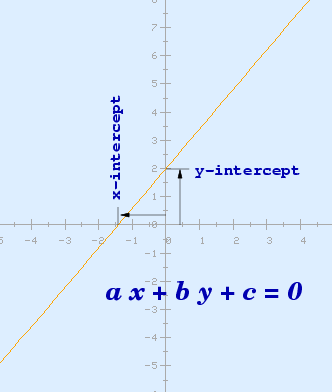
The y-intercept is the
ycoordinate of the point where the line intercepts the y-axis and the x-intercept is thexcoordinate of the point where the line intercepts the x-axis.The y-intercept of the line in this graph is exactly .
The x-intercept of the line in this graph is almost .
- A straight line in the xy-plane always has an equation in this general
form
a x + b y + c = 0where
ais the coefficient ofx,bis the coefficient ofy, andcis the constant term.A straight line always has an equation in this form and the graph of any equation in this form is a straight line.
Any point with coordinates
(x1, y1)is on the line if it satisfies the equation which means if you subsitute the valuex1forxand the valuey1foryin the euqation, the resulta x1 + b y1 + cis actually equal to zero.
 Assuming the x-axis represents the horizontal and the y-axis reprents the vertical, then the slope of a straight line measures
how slanted or steep the line is relative to the horizontal or vertical.
Specifically, the slope is the change in
Assuming the x-axis represents the horizontal and the y-axis reprents the vertical, then the slope of a straight line measures
how slanted or steep the line is relative to the horizontal or vertical.
Specifically, the slope is the change in y
per unit change in x.
For example, a horizontal line has slope zero
and a vertical line has slope infinity.
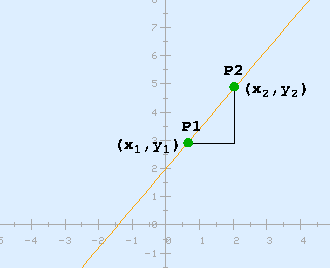
In general, the slope is:
| slope = | change in the y coordinate |
change in the x coordinate |
Written out explicitly, this means
| slope = | y2 − y1 |
x2 − x1 |
computed using any two points P1 and P2 on the line.
Given the equation of a line, we can find its slope using the above definition. But there is another way that may be easier. By putting the equation of a line in the slope-intercept form
y = m x + b
you can easily obtain the value for b, the y-intercept, and the
value for m, the slope.
Let's try taking an equation and transform it into the slope-intercept form. First, enter a line equation of your choosing:
x + y + = 0
And it is displayed here. Numbers are rounded to the nearest hundredth.
You can transform this equation into the slope-intercept form by solving for
yin terms ofxthrough a sequence of steps, by adding, subtracting, multiplying or dividing both sides with the same quantity.-
Enter a number or a multiple of x (for example 2 x and -4 x) and click a button and the operation will be applied to both sides of the latest equation and produce an equvalent new equation:
x
Try and do another equation.
Here is a diagram where you can interactively enter a straight line. Then you can move the y-intercept or rotate the line by dragging the intercept point or the line. As the line changes, you'll also see the equation for the line change.